Showing posts with label Kurt Vonnegut. Show all posts

Monday, January 09, 2012

book review: Bagombo Snuff Box uncollected short fiction by Kurt Vonnegut

"When Kiah got the car into the six-lane turnpike, he ceased feeling like an intruder in the universe. He was as much part of it as the clouds and the sea. With the mock modesty of a god traveling incognitio, he permitted a Cadillac convertible to pass him. A pretty girl at its wheel smiled down on him.
Kiah touched the throttle lightly and streaked around her. He laughed at the speck she became in his rearview mirror. The temperature gauge climbed, and Kiah slowed the Marittima-Frascati, forging himself this one indulgence. Just this once - it had been worth it. This was the life!"
Quote from The Powder-Blue Dragon.
There are several themes that come out of this collection of stories that were written by Kurt Vonnegut at the start of his writing career. He was penning these ideas at a time of great change in his home country. The Second World War had been won and the materialism that dominated the 1950s was yet to be overtaken by some of the dark times of the 1960s. But even with cars and dishwashers becoming things the common person could dream of what came with that technology was change and its that sense of tension between the new and the old that forms one of the main themes of this collection.

He is brutally honest about his work in an introduction and coda to the collection of 24 short stories revealing that he had to edit some of them to get them into a condition he was happy with to have them republished in his volume.

One of the themes is around the idea of technology and success with the materialism of post-war America starting to dazzle even those that previously might have thought car ownership was beyond them.

In The Power-Blue Dragon a car mechanic buys an Italian racing car in a purchase designed to show the world just what sort of man he is. The car has the ability to turn heads but few pay much attention to the boy driving it. The lesson here is that respect is something that cannot be bought with a cheque and happiness will not always result after flaunting wealth.

That idea of flaunting wealth is at the heart of The Package which starts with a man and his wife returning to a state of the art house after a holiday abroad. He has sold his factory and made millions and he is happy to let an old school friend look him up. The chance to show off and bury the resentments of the past are just too good to miss but at the end the arrogance caused by success and wealth blinds the main character from the truth. He has a victory but it is a hollow one.

Drawing on his background working for industry there are numerous references throughout the stories to the workings of large corporate entities and the men who run them and the people who work for them.

A post-war generation looks for excitement and a chance to sell-off the factories and hard work of their parents just to feel they can live. Of course they can only 'live' because of the effort made by their parents.

That theme is shown in both Runaways and This Son of Mine, where in the first story a poor boy falls in love with a Senators daughter. When the union is given the blessing of the parents the attraction of rebelling against authority falls away and the loveless relationship is laid bare.

In This Son of Mine a factory owner finds his highly educated son reluctant to take over the factory. Emotional blackmail and weakness lead the status quo to remain but without happiness on either side of the generational divide.

One of the other themes here is music, particularly in the form of the high school band. One band and band master crop up in two stories Ambitious Sophomore and The Boy Who Hated Girls charting the lengths to which people will go to to be part of a band and to stand out for their town. The sense of proportion is lost by band leader and band members alike as they pursue a dream which seems so limited in the face of the concerns of real life.

But if there was one other riff that chimes through this collection it has to be around the impact of change. Remember Vonnegut is a man changed by war, what he saw and what he experienced, and other characters are in the same position, as in the story Souvenir. But it is not just war time scars that continue to cause problems it is the sense of technology changing the way we all live.

The time and motion man who turns up in a town, in the story Poor Little Rich Town and rewrites how people live just to save time and money fails completely to understand the emotional reasons people do things and the hidden costs of saving money.

If you want a taste of classic Vonnegut, mixing the sci-fi and the fantastical with the modern and routine, then ironically it appears right at the start of the collection in the story Thanasphere. The idea that there might be ghosts in space is a clever one and this is hauntingly told.

But there is so much more to Vonnegut than just running wild with his imagination on the boundaries of space. What this collection shows is that he can deliver character, depth of emotion and deal with some very large questions all in the boundaries of the small story format.

For those that have not read his short stories, and my hand was raised before opening this book, then it is worth having a read and getting a different take on the American Dream when it was starting to really get going.

Friday, July 24, 2009

book review - Breakfast of Champions - Kurt Vonnegut


Going from Cats Cradle onto Breakfast of Champions this is a book that quickly reminds you of Slaughterhouse 5 in a much more direct than Cradle. The science fiction writer Kilgore Trout is back in the spotlight but Vonnegut is having fun with the writing process here spinning the relationship between author and his creations.

The phrase Breakfast of Champions is an advertising slogan for a cereal and one of the main themes of the book is around consumerism. This is an America that has grown fat on its own economic success. The main setting Midland City, is a town shaped by the money of car dealer and hotel owner Dwayne Hoover, who is slowly but surely having a breakdown as the story unfolds. He becomes increasingly unstable as his life of luxury and boredom unravels. The final push into insanity comes when Hoover meets Trout at an artistic convention and reads some of the sci-fi author's work.

As Hoover loses it and some of the other characters are dragged into his destructive breakdown Trout heads off for a meeting with his creator - the author. As Vonnegut flips the conventions of a normal book to challenge the perception of what is reality you have to ask if you are also facing a Hoover moment. After he reads a message from the creator telling him to shake off the shackles of being a robot and show free will are we also trapped in the same way?

Vonnegut is encouraging you to ask what really constitutes happiness. What is success? If you are so tied into a system that prevents you from expressing your true feelings then are you in fact not much better than a robot being controlled by society. Of course that message, which is enough to start a spiral of self introspection, is wrapped up in great humour and imagination. It is impossible not to review the book without making a mention of the illustrations that Vonnegut litters the text with. They are not only funny but help immerse the reader into some of the signs, shared language and consumerism of mid-town USA.

The more you read Vonnegut the more you get to his motivation. If Dostoevsky was determined to spread the message of brotherhood then here is an author equally passionate challenging you to think about what is real. As the money flows and the neon signs get brighter and those with wealth become more removed from reality it becomes frightening. Overlay that with nuclear weapons, a race on the scientific front to produce ever more deadly and mysterious weapons and you have plenty of material. The way Vonnegut can weave it all in and leave you not only wiser but wanting more is the sign of a great writer.

Saturday, July 04, 2009

book review - Cat's Cradle - Kurt Vonnegut

This book is going to rank as one of my favourites of the year; it is certainly one of the best of the first six months.

The reason why is because of the clever mix of satire, wit and science-fiction that are weaved together by Kurt Vonnegut. He manages to describe the end of the world in a way that both horrifies and amuses which is no mean feat. The way he does so is to describe and develop a select cast of odd balls that have the power to destroy the world left to them by a man who almost did just that.

The idea of a writer following through what happened to the fictional co-creator of the atom bomb Felix Hoenikker on the day the bomb was dropped on Japan is where the book starts. But quickly the narrator moves away from his original purpose and starts to follow the threads of Hoenikker’s dysfunctional family. The scientists three children are all damaged by an upbringing starved of love and normality. One has become a dictator’s aide on a remote island in the Caribbean, another a strict repressed clarinet playing housewife and the last is a dwarf who has a history with the circus and an equally small Russian spy.

What ties them together is their father’s last deadly discovery, Ice-9, which has the power to turn water instantly to ice. The impact of using it would be to freeze the oceans and rivers and bring about an environmental catasprohe not too far removed from nuclear war.

And that is the point because this is set against a backdrop of the cold war and the horror that a bunch of idiots in positions of power could, as easily as mistakenly dropping a chunk of ice-9 into the sea, press the button and end the world.

What keeps you reading is the humour and the various sub-plots with a primitive religion holding sway on the island making the remote Caribbean world seem like a million miles away from civilisation.

Underneath the occasional oddity and incredibly imaginative story lies a biting commentary on the era. Even down to the cycle factory owner who is relocating from Chicago to the Caribbean to exploit cheap labour this book is picking big targets including consumerism, nuclear war, and the shallowness of power and the dangers of science.

Just because it is possible to invent something in a lab that can destroy the world is not necessarily a reason to unleash it on the world. The lethal mix of science, politics and war which became so visible with the mushroom clouds is a fear that might have been acutely heightened in the 1963, when Vonnegut published this book, but they still speak to us now.

Thursday, June 04, 2009

Breakfast of Champions - post III

The Breakfast of Champions introduces a technique that other authors hint at but never go the whole hog with. Occasionally you are reading about a main character and an author will slip in some sort of preview about what is going to happen next.

You always suspect it is aimed at preventing boredom or convincing you that a main character is going to be alright in the end. Vonnegut keeps telling you that Dywane Hoover is going to go mad and that Kilgore Trout is instrumental in it. But the reason he keeps telling you that is because he is showing just how much he is in control of the story. Because he suddenly has the creator of the fictional world sitting in the middle of the action wearing a pair of sunglasses in a dark bar.

he takes fiction to somewhere that it rarely goes and it leaves you asking just who is in control of our lives and just why are the limitations on our horizons accepted as if they were established background to introduce a chapter sketching out the landscape?

The world that Trout and Hoover inhabit is sick and dying and despite the attempts of major corporations to pump some positivity into it through marketing messages "the breakfast of champions" it just makes the unreal nature of our existence all the more obvious to Vonnegut.

This is a bit like watching a flim with the last third ending up with you sitting with the cast and crew and the film happening all around you. The power with that is that after you get used to the idea you start asking why the film is being made in the way it is, why the characters are acting in such a way and wonder just why the world they inhabit is so bleak and artificial. If nothing else Vonnegut gets you thinking.

A review will come soon...

Friday, May 29, 2009

Breakfast of Champions - post II

As Trout gets closer to meeting Hoover the sense of impending doom is stoked up by Vonnegut. The stupidity of truck companies named after immovable objects like pyramids and the yearning that those he hitchhikes with have for some knowledge that somewhere someone is happy is pitiful.

What makes something bad almost inevitable is the state that Hoover starts to get himself into finding the ‘bad chemicals’ in his brain make him lose his grip on reality.

There is a great line in a discussion between Dwayne Hoover and his mistress Francine that shows just how difficult it must have been for someone who feels that the consumerism and hollow society around them is killing them:

“We could go to some other city,” said Francine.
“”They’re all like here. They’re all the same,” said Dwayne.


She then suggests he meets someone different, someone like Trout, without of course understanding that the consequences could be quite serious for someone on the edge of their sanity.

More next week...

Thursday, May 28, 2009

Breakfast of Champions - post I

It took me a criminally long time, well after Slaughterhouse 5 and the Jail Bird, to finally 'get' Vonnegut and now having understood it, then it is simply a race against time to read as much of his work as I can afford to acquire.

The combination of humour, sci-fi but also a very strong but subtle commentary on world affairs is done in such a way that it feels as if once you appreciate it you have somehow landed membership of one of the coolest clubs around.

What adds to the experience here are the author illustrations. Little line sketches in pen that actually connect with the text in a way illustrations often fail to do. They add to the sense of disconnection between ordinary things and completely strange reactions they cause.

At the centre this is a story of two men who are travelling to meet each other and have an impact on each other's lives. One is a lonely science fiction writer Kilgore Trout and the other is millionaire businessman Wayne Hoobler. The influence of Trout on Hoobler is going to come at a time when the businessman has already lost his grip on reality.

But of course the point here is a wider one about what is reality anyway in a country where odd things seem to be hard wired into the norm.

That is the gift of Vonnegut because he gets you to see things with a different eye. As you laugh you also start to think.

More soon...

Friday, May 22, 2009

Cats Cradle - post III

The feared end of the world comes in the most comical way imaginable with an ice-nine victim sliding down a broken castle parapet into the ocean. But that is the power of Vonnegut because the point he is making is that the end of the world could come as a result of idiocy. In fact it is almost inevitable if you give power hungry amateurs the power to destroy the world then they will potentially do so without even thinking about the consequences.

Although this would have no doubt have been read differently at the height of the cold war when not only was the end of the world possible but also seems likely with Cuba, Kennedy being shot and the Russians up to all sorts. But there is also a flip here about the fact that this is science fiction with the made up religion and the island republic in the Caribbean but at the same time it is satire. What makes it so readable is the humour. Despite the doom and even the death this is all done with a wicked smile. I guess you have that choice of either laughing or smiling and maybe doing the latter is the best thing to do, even in the face of total destruction.

A review will follow soon...

Thursday, May 21, 2009

Cats Cradle - post II

Vonnegut starts to leave the original idea of a writer putting together a book about the normal things that were happening on the day the atom bomb was dropped in the second world war and instead starts to weave together a story around ice-nine, the invention of the late Dr felix Hoenikker, one of the founding fathers' of the atom bomb.

As Vonnegut starts to chase up the leads of the Hoenikker family and starts to pull together the story of the invention of ice-nine there is a distinct gap between the care-free and laid back characters of the 1960s and the sheer horror or the potential invention that could freeze the water on the planet and make the atom bomb look like an very isolated incident. Vonnegut's narrator remains slightly cool with the knowledge and allows coincidences and plot developments to happen around him without too much comment or involvement but you sense that the show down is coming with the Hoenikker children, who each have a chunk of the deadly ice-nine.

More tomorrow...

Wednesday, May 20, 2009

Cats Cradle - post I

I didn’t really get the humour of Kurt Vonnegut in Slaughterhouse 5 partly because it wasn‘t that funny a thing the Dresden bombing.

But you get the humour here and it makes the alien excursions with Slaughterhouse much more understandable. It’s as if the wanderings into the bizarre are a very visible shorthand to remind the reader that not only is this fiction not fact but that reality can be strange anyway. He is challenging the reader to think.

Not only to think but embrace characters that are often unusual being either too tall, too short or too clever.

But underneath it all there is a real sense of the dangers of science. The atom bomb is the most visible example but the idea of Ice-9, a chemical that can freeze water regardless of the conditions and temperature, shows how dangerous science and the ideas of scientists can be in a cold war context.

More soon…

Friday, October 12, 2007

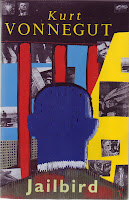
book review - Jailbird


Having enjoyed the story of the time travelling war veteran alien abducted character in Kurt Vonnegut’s Slaughterhouse 5 it was with some trepidation this book was picked up. Not because Slaughterhouse was bad, far from it, but because you just didn’t know what was coming.

This book has a similar feel with the main character Walter Starbuck reviewing his life and the mistakes that led him to be a widower in prison without friends or future prospects. The difference is that the flashbacks are done without the help of alien intervention and unlike the lead in Slaughterhouse Starbuck does not know what will become of him from the moment he is escorted out of the prison gates by president Jimmy Carter’s cousin.

After that moment there is an interweaving of different stories about Starbuck's youth, career in the Nixon administration, marriage and his status as a despised sneak who ruined the career of one of his friends by mentioning they had both been in the communist party when grilled by the authorities.

Throughout the narrative there are constant references to a multinational corporation RAMJAC that owns everything from Vogue to McDonalds. Vonnegut brings the connection to Starbuck via the mysterious owner of the corporation who turns out to be one of Starbuck’s first girlfriends who saves him from destitution by appointing him as a vice president of the corporation.

But the reason why this book sticks in the mind because of the clever way it approaches some of the big debates in US politics and society. Is capitalist greed right or is a more socialist alternative the answer? If you are influential enough will you ever be really punished by the state? Is Jesus the answer for those who have nothing?

Then there are other more personal questions that he raises. What makes you successful - is it by sucking up to the right people or actually doing a good job? What constitutes personal success and can you be happy with no possessions?

Starbuck is a mirror not only to those debates but also challenges them by being part of the guilty Nixon administration, serving time, but also looking in from a position almost on the outside. Just like Billy in Slaughterhouse Starbuck seems to have his own morale compass and drifts through life frustrating those around him who are seeking to make him conform.

At the end of the book Starbuck is heading back to prison but this time, because it is seen to be for reasons that benefited rather than injured his friends, he is given a send off. The biggest question of all is whether or not a corrupt country is able to punish anyone and if those trying to turn the tide and share the wealth will ever manage to make a difference. Those are weighty questions and the fact that Vonnegut gets them across without preaching is a testament to the ability of his style.

Thursday, October 04, 2007

Jailbird - post IV

The book comes to an end with Starbuck again heading back for prison but this time he is given a friendly send off from those who are grateful for what he has done.

You are left pondering what the message is and it seems to be that even if you try to do something honourable then it goes against you in a society that is so susceptible to corruption and fear of actually sharing its wealth with its own people.

The dream of the secret owner of RAMJAC to spread her wealth among all Americans collapses under administration and legal fees and the cold reality of globalisation.

Bullet points between pages 200 – 241

* Having worked out who Mary Kathleen actually is after his interview with the public head of the RAMJAC he decides to head back to see his old flame in the hidden rail repair sheds in the bowls of the railway station

* Mary has been hit by a taxi and is slowly bleeding to death in one of the unused toilets and she tells Walter what her vision had been of what she wanted to do with RAMJAC, eventually giving the company to the American people

* She tells him how her wealth had meant she could never be happy because she was always haunted with the thought of being captured and having her hands cut off because that is the only way of identifying her ownership of the company

* Walter claims her body and she is buried but by some twist the cemetery worker tells someone he know with the same name and he has the fingerprints checked to see if he is related and it comes out that Starbuck hid the death of the legendary Mrs Jack Graham owner of the RAMJAC corporation

* Things rapidly fall apart and as a result of keeping her death hidden Walter faces jail and says goodbye to everyone for the second time but this time his speech in front of Nixon that cost his best friend his freedom is applauded and this jokes are appreciated – there is life after political death

A review will follow soon…

Wednesday, October 03, 2007

Jailbird - post III

A colleague from another magazine that works next to mine wandered over and picked up my library copy of Jailbird and commented that Vonnegut was a tight writer but weird. That didn’t seem to bother him so I recommended this book promising it would match both of those requirements.

The comment about tightness is particularly apt because things do fall into place and the same sort of feeling of time travel you get in Slaughterhouse 5 is here but based on memory rather than alien intervention. There is only one place where the reader realises what is happening long before Vonnegut tells you but then he pulls the authority over the story back with a twist that you did not see coming.


Bullet points between pages 130 – 202

* Things go from odd to odder for Walter Starbuck as he greets his old friend, the one he put in prison, who thanks him for the opportunity to discover that life is meant to be a trial

* But their discussion is interrupted by a mad bag lady who identifies Walter and then starts trying to talk to him – you realise that is his second great love from his communist activist days – and he finally recognises her as Mary Kathleen

* He hugs her and she drags him to a secret area in central station and then up to the top of the Chrysler building where for some reason Walter decides to tell the owner of the American harp company that he has some stolen clarinet parts to sell

* While waiting for the police, which he doesn’t know are coming, he tells his old flame about all the nice people he has met since he left prison ranging from the prison guard to his old friend who he had helped put in jail

* He is then whisked off to jail and dumped in the basement in a padded cell where he goes through the motions of having a breakdown before one of the best lawyers in the city comes to spring him

* The reasons why the lawyer has come is because the bag lady turns out to be one of the richest women in America the secret force behind the RAMJAC corporation which has been mentioned throughout the book owning everything from Sesame Street to MacDonald’s

* In the car are all of the people that Starbuck has mentioned to the bag lady and they are dragged off to the public face of RAMJAC to be told that because they are virtuous people they are to be given executive jobs in the company

More tomorrow…


Jailbird - post II

Without going overboard Vonnegut paints a picture of corruption not just in the Nixon administration but also at the heart of the top tier of American politics and business. As he links in with themes not just of Watergate but also how large corporations are running most of the country he is able to build up a much more subtle indictment of corruption than if he had gone for its hammer and tongs.

Bullet points between pages 40 – 130

* Walter Starbuck is a difficult target for the zealous Christian trying to have one last time converting him to the right path before Starbuck leaves prison and the lead character is finally taken out of his cell by his guard

* As he wanders over to the main gate and freedom he coincides with the arrival of one of the senior government ministers being sent into serve his term for corruption charges

* Starbuck gets in the convicts limousine and heads off into the city and then travels to New York to stay in a hotel he once stayed the night in when he took his first girlfriend out for a meal

* It was a disaster because he had been told to behave like an aristocrat by his mentor Alexander McCone and he blew it by over tipping a violin player and appearing to rub his dates nose in his wealth

* He came clean about what he was doing and they became friends but never married because she ended up with one of his good friends Leland Clewes, who Starbuck had betrayed in the anti-communist witch hunt of the post-way years

* His betrayal of Clewes, who served time in prison and had his political ambitions ruined, lost Starbuck a lot of friends and made it very difficult to get a job or even now have someone to lean on after he came out of prison

* He heads back to New York stays in the hotel where it is so run down they are amazed he has made a reservation and then he wanders into the quarter of the city where his old betrayed friend lives

* He spots Leland Clewes before he in turn is seen and although he could turn and walk away he stays rooted to the spot making a meeting between the two old friends inevitable

More tonight….

Tuesday, October 02, 2007

Jailbird - post I

Before starting this the only other Vonnegut book I had encountered was Slaughterhouse 5 and this starts in a similar way with a prologue that seems to be providing you with the motivation for the story and the background. It is enjoyable to read and written with feeling, particularly the bits about the strikers being shot, but all the time you are trying to work out what it has to do with prison or, after you turn the first page of the novel, how it relates to the Nixon era.

The same strange feeling of not knowing what was coming next was felt with Slaughterhouse 5 so there is a bit more comfort there that this is going to be fine and the references made in the prologue will become important.

Bullet points from the prologue and pages 1 - 40

* The prologue talks about all manner of things but mainly concentrates the story of the McCone family, which owned a steel plant and decided to put out strikers and leave them to starve rather than reemploy them after the strike had broken

* The strikers come to demonstrate and the McCone family have hired sharp shooters to shoot and sure enough 14 demonstrators are gunned down and the youngest son in the steel magnate's family Alexander becomes a stuttering wreck and leaves the family firm

* He has no friends with his wife and daughter living apart from him so he plays with the cook and driver's son who he decides should follow in his footsteps and become a Harvard man - there is a fair amount of stuff about the virtues, or lack of them, of being a Harvard graduate

* That chess playing boy grows up to have a role in the Nixon administration and end up being sent to prison along with a host of the presidents other political team for embezzlement and other crimes that spilt out from the Watergate affair

* The main book starts with the character of Walter Starbuck about to leave prison to try and pick up the pieces of his life with a son who hates him and a wife that died just a couple of weeks before he started his three year prison term

* Although it is for crimes commit ed by the Nixon administration he is behind bars he only came to the attention of the president once and was largely an non-entity that smoked and churned out memos and reports no one read from a basement room

* While he waits for the guard, Jimmy Carter's cousin to come and release him, one of the other inmates who has found religion comes to try and convert him and points out to the bitter and cynical Starbuck that he has no friends whatsoever so why not be friends with Jesus

That has hardly done justice top what is a clever, passionate and intricately weaved introduction but it should at least tempt you to pick this up and have a read. More tomorrow...

Saturday, September 22, 2007

book of books - Slaughterhouse 5


Whenever a famous author dies that you had never read one of the first impulses after reading and hearing the tributes is to go and discover what it was all about. That feeling swept over me when Kurt Vonnegut sadly died earlier this year and after failing to get Slaughterhouse 5 out of the library for reasons of popularity in the end I bought it and sat down to read arguably his most famous novel.

The blurb on the dust jacket actually gets in the way because comparing it to Catch 22 and talking about it almost being indefinable make it difficult to enjoy with an open mind. You really do need that open mind because this is a story that is all over the place as a result of the use of time and is also all over the place in its connection with reality.

You have to try to understand that the central character Billy Pilgrim - an odd man on an odd sort of Pilgrim's Progress through trial and tribulations until the bullet comes in 1974 - is as much a metaphor for the destruction of war as he is a literal character stuck in the middle of one.

Plot summary
The first couple of chapters are an introduction to the novel and Vonnegut's mission to write an epic using his experiences as a prisoner of war in Dresden during the time the allies turned it into a firestorm. He admits that not only has the idea been in his head for a long time but it is also one he has struggled to get going with because of his problems remembering the war. Then Billy Pilgrim is introduced. This time travelling optometrist is next to Vonnegut in the prison camp and in the aftermath of Dresden when the prisoners are made to work digging out the corpses. But Pilgrim believes in aliens and has been abducted and been put in a zoo on their planet and even had a second wife and child up in space and as a result is able to travel in time and so skips through his life going back and forth remembering things and people knowing what will happen next. His wife dies, his friends die and in the end he even knows when he himself will die. But he carries on with his life and time travelling and ends up remaining the figure of the clown that he had been given in the war. The name of the novel comes from the name of the place the prisoners are housed in Dresden and they are told that if they ever get lost they are to ask to be taken back to slaughterhouse 5, part of the city abattoir that lies dormant as the fresh meat never comes.

Is it well written?
It is an easy book to read in terms of style and length but it is a difficult novel to get to grips with. Is Billy Pilgrim mad about the time travel, which could result from the trauma of war? If he is right then is it trying to suggest we are a primitive world for doing acts like Dresden to each other? Or is it just a crazy mixed up way of using arresting characters to get you to think about the futility of war? I suspect it is a mixture of all three and probably some other things as well. The point that Vonnegut is trying to make is laid out in the introduction when he meets the wife of an old solider friend who accuses him of planning to write a book that will glorify war, He does the opposite and with his expression 'so it goes' after each death you start to get the impression that no one really cares about body counts and innocent victims in war. You also get the clear message that for those who end up fighting in them and surviving then it destroys them slowly. The madness of destruction on a scale that Bomber Harris and his friends visited on Dresden would alter your perception of reality. This book makes you wonder about war and its victims and you are left wondering just why anyone would want to fight people like Billy Pilgrim. As a call for peace it is subtle but powerful nonetheless.

Should it be read?
There are various reasons why this should be read including the style, which is confident and different from most traditional narratives. Also there is the subject, which is ultimately about a man trying to recover his memory about the past and piece together what happened and facing up to the horror. But it also deserves to be read because the person who wrote it was part of a generation that saw action, saw death on a scale we today cannot imagine and then tried to translate that into a novel that would not only be something generations that lived through peace could relate to but something that would plant a seed in the mind that when fully germinated - and it probably takes months if not years after reading this book - then you start to appreciate the disorientating and mind bending impact that war can have and why it is not something we should ever wish for.

Summary
Time travel, aliens and the horrors of war might all seem like illusions and madness but of all three the horrors of Dresden were only too real

Version read - Vintage paperback


Monday, September 17, 2007

Slaughterhouse 5 - post III

Because I was dropping a wardrobe off for a colleague at work I drove into today and that meant no reading. Add to that a business lunch and there was no chance to even pick up a bit of Poe. I’m almost running out of time with the Poe and am in my penultimate week to get the review over to the Penguin Classics site so will get stuck back into that tomorrow.

In the meantime there was a chance to get through the final pages on the Vonnegut. An odd book but very powerful in the end and one of those slow burners that twists and turns in your mind as it fuses all sorts of thoughts.

Bullet points between pages 124 – 157

* Billy Pilgrim time travels between the war, his wedding and his death meeting some interesting people on the way including the science fiction writer Kilgore Trout who has never met a fan before and lives in the same town as Billy

* Billy is reminded of his anniversary night when the optometrist barber shop quarter, who were to die in the plane crash, sang and the expressions on their faces reminded him of the horror of war

* Back on the planet run by the aliens he has fathered a child with ex porn star actress Wild Montana and the gossip papers speculate that she has been murdered to try and explain her long absence

* Billy’s wife Valencia dies trying to visit him in the hospital after getting carbon monoxide poisoning after losing her exhaust in a car crash and for days Billy appears to be a vegetable that can take nothing in

* But when he does talk he is happy to share his recollections about Dresden and the night it was bombed and the moon like appearance of the dead space that remained afterwards and although historians argue it was justified in war it killed tens of thousands of innocent people

* Billy along with Vonnegut were put to work to try and dig the corpses out of the rubble and the book ends with that image of the horror of death on a mass scale being enough to flip anyone’s mind looking for a way out of a planet that is full of people that can’t help killing themselves

A review will follow shortly…


Saturday, September 15, 2007

Slaughterhouse 5 - post II

There is a real method in the madness here with Billy Pilgrim going from an alien zoo to a prisoner of war camp in such a seamless manner that the whole idea of time travel back and forwards suddenly seems very familiar. It almost doesn’t matter if you don’t believe it because the point here is to investigate the impact war makes on individuals and Pilgrim’s problems are not designed to be an advert for war.

Bullet points between pages 86 – 124

* The prisoners are moved to Dresden to an old abattoir and are told that if they ever get lost and need to get back they should give their address, which is Slaughterhouse Five, and they will et sent back to the makeshift camp for 100 American soldiers

* In his time travelling Billy recalls more episodes in the alien zoo and the moment when they brought him a mate who was the opposite of his large and ugly wife who every time she appears in the narrative is chewing a different branded candy bar

* He also knows that when he boards the plane to an optometrists conference with his father-in-law that everyone except him and the co-pilot will die when the plane hits a mountain

* He also knows that he will be shot by a nutter he meets in the war who promises to avenge his friend Roland, who blames Billy for his death, and he finally gets Billy in 1976 as he comes off stage speaking at an alien abduction event

* Back in Dresden the Americans are trying to be convinced that they should sign up for a Nazi fighting corp on the Eastern front but no one is interested and as Billy alone knows the next night the bombers will come and will destroy most of the city

More maybe tomorrow…


Friday, September 14, 2007

Slaughterhouse 5 - post I

Never having read any Vonnegut it takes a little bit of getting to grips with. It helps because you get a rambling opening chapter that acts as both as scene setter as well as an introduction to the style of writing that is to come.

In terms of style it is on first appearances quite disconnected anecdotes but you start to realise that things are linked and there are echoes that crop up and make you appreciate the skill. So it goes.

Bullet points between pages 1 – 86

* Vonnegut starts by revealing that he was a prisoner of war caught in the Dresden firestorm caused by the allied bombing and had always planned to do a book about it but couldn’t really remember much to do with those days

* He contacts an ex military buddy and starts to talk to him about the past and after convincing his wife it will not be a pro-war memoir he sets off to try and tell the story of the past

* Things really start in the third chapter with the arrival of the central character Billy Pilgrim who is introduced as an old optometrist who is a widower and happy writing to the local newspaper about the time he was abducted by aliens

* He is told to stop talking about his space adventures by his daughter but Billy is a time traveller and the story skips across his birth, marriage and his war years where he was captured behind enemy lines limping along in his assistant chaplains uniform

* Once captured he skips back and forth in time recalling the adventures in the space ship and the zoo he lived in on the alien world, his spell in a mental hospital after the war, his marriage to an ugly rich girl and his relatively stable but uninspiring family life

* The weaving in of the abduction and the capture make you feel as if one experience triggered the other and there is the suggestion of a fourth dimension but there is also the hint that just as time travel with aliens might seem intensely bizarre so does fighting against your fellow man

More tomorrow…