Showing posts with label Andre Gide. Show all posts

Monday, February 14, 2011

book review: The Counterfeiters by Andre Gide


This book might perhaps suffer in terms of pace in the first half but once it gets going it moves towards an end which seems to come almost abruptly when it does arrive.

The main theme of the counterfeiters which comes from the title of the book that the writer Edouard is writing also plays out in real life with a ring of boys being used to palm off counterfeit coins through Paris. But the sense of fraudulent feelings and actions pervades the book. Some characters come across as so prepared to hide behind a facade that you never really get to know them.

But intertwined with the sense of fraud is the theme of coming of age. This is both in the practical sense with Bernard and Olivier leaving school and becoming men but also in the way that even some of the oldest characters are clearly still learning who they are and adapting to circumstances.

The story starts with Bernard discovering that he is illegitimate after he breaks into his mother's bureau and discovers letters not intended to be seen. That idea of damaging secrets that is introduced in that moment remains throughout the book. Grandfather's secretly writing to their grandsons, barristers carrying around letters from their mistress and in the most extreme case a woman, Laura hiding her pregnancy by Olivier's brother Vincent from her husband.

In one sense this is about two families and two particular sons from each family - Bernard and Olivier - charting them as they take their first strides into adulthood. They dream and aspire to great things but have great vulnerability that allows others to help or exploit them. They fall in love easily, bruise easily but by the end of the tale learn that home can often be a comfort rather than a prison.

Throughout the book there are questions about writing that are thrown up as Edouard struggles to get to grips with The Counterfeiters. He faces his arch enemy, the celebrated writer of the moment Comte de Passavant, who seems to treat writing as a hobby and success as a given. The differences between them highlights the danger with feeling too much and not feeling anywhere near enough with Passavant left with an inflated reputation but little in the way of friendship and love.

Gide also uses an Eric Morecambe style voice to the reader revealing that he has struggled to like some of his cast of characters and giving the signpost to the second half of the book. That voice is at first slightly unusual but becomes increasingly familiar and as a device works fairly well.

There were moments when you wondered where this was going but by the end there is a sense that although the counterfeiters don't always get caught they suffer justice in the form of loneliness, guilt and in the case of Vincent the man who left Laura pregnant and fled overseas, it can leave them without much of a sane mind left.

Thursday, February 10, 2011

Thoughts at the half way point of The Counterfeiters

Having set up the small cast of characters Gide starts to interweave their stories shaking the tree and dropping seeds throughout that could grow into fairly major story lines or alternatively could get shirked off. part of the experience of reading this is not knowing quite how the story is going to develop.

The other feature of the writing that you start to enjoy is the way that Gide treats the reader as someone that is able to follow the story without the need for a great deal of hand holding. So the voice of the narrator occasionally turns towards the audience and he explains that certain details are really not worth going into or lists the main features of a character to minimise the break in the story.

Love is at the heart of the story but so is the question of deception. The main characters are playing their cards close to their chests and as the reader gets more of an insight into what is happening things are being set up where the masks are going to be forced to slip.

At that moment Gide's talent as a writer should shine through because otherwise the good work done so far will have failed to get the climax it deserves.

More soon...

Wednesday, February 09, 2011

Thoughts at a third way through The Counterfeiters

Because this is a fairly dense book, not just in terms of pagination but the style, it seemed like quite a good idea to do thoughts in thirds.

It is also a book that takes the reader into some difficult territory with an Uncle falling for his nephew and that sense of the illicit and disturbing is coming through in the first third and is perhaps the one strand of the story that is less appealing than some of the others.

In terms of subject it reminds you of Proust with a more limited character list. Concentrated on the social world of a couple of rich Parisian families the story starts with a illegitimate son of a judge discovering the secret and leaving home. Bernard chooses to head to his best friend Olivier as soon as he leaves home and as a result through a couple of 15 year old's you are given an insight into the two families.

As Bernard chooses to break away he becomes an informed observer to the affair that is being carried on by his friend Olivier's brother Vincent and watches from a distance as Olivier's uncle Edouard arrives in Paris.

You sense that the relationships between the two families, at different levels, and the coincidences that often happens through previously unknown friendships will become more interesting.

A post on the second third then a review will follow...

Tuesday, February 08, 2011

Encounters with Gide

As I set off reading Andre Gide's The Counterfeiters thought it might be handy to remind myself and the small band of readers of this blog of my previous encounters with Gide.

His writing can wander into the philosophical and religious territory but he is a brave writer that is prepared to tackle difficult and interesting questions. He is also a very honest writer using the editor's preface to confess to faults in his books and in the case of Fruits of the Earth to poor sales.

Here are the other Gide books I have read over the past few years:


Strait is the Gate


The Immoralist


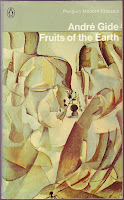
Fruits of the Earth

Saturday, February 23, 2008

book review - Strait is the Gate


There is a style of writing that sets up a character to embody an argument as a way of life and Andre Gide delivers a great example of that here.

Where there should be happiness and love there is despair and death. Ironically the reason for it is because of a zealous devotion to God. This is a book about the sort of religious devotion that causes people to become martyrs and lose out on happiness because it is somehow sinful to enjoy life.

In a nutshell this is a love story about a boy - Jerome - and a girl – Alissa - who grow up to become a man and a woman. They are clear about their plans to marry from their teenage years but not far after reaching the point where an engagement would be announced in the lead-up to a marriage things start to go wrong.

The first sign that Alissa is prepared to sacrifice her own happiness comes when her sister falls in love with Jerome. Alissa steps back and is prepared to step aside for the sake of her sister’s joy. Once that fails she still seems determined to sacrifice her love with Jerome. He has to go away and further his studies and carry out his military service but she keeps him at bay. The weeks stretch into months and still Alissa keeps him at arms length.

Even after her sister has married and that reason for sacrificing Jerome has disappeared she continues to try and sabotage her love. Finally the extremes are reached with her dressing in a way that will make her appear to be a frump and she also makes the decision to dump the literature he has sent her to read quant religious texts instead.

Inevitably the end comes with her rejecting Jerome for once and for all and then dying of a broken heart after he fails to return as she secretly hoped. Her victory over her heart has been complete but it costs Alissa her life.

Diaries passed onto Jerome after her death reveal how Alissa had hoped that he would come back for her even after all she had done to dissuade him. He remains devoted to a memory and in a telling exchange with Alissa’s sister he tells how he will love her forever and she reveals, to the reader at least, that she has always loved Jerome.

The fact she still loves Jerome must have been known by her sister. The determination of Alissa to reject Jerome and all that he had to offer was a supreme effort that could only be supported and driven by a belief in God that sustained her effort.

For Jerome the irony is that he has been consistent all along with his love for Alissa but unbeknown to him it is the complexities of the heart that are happening all around him that seal his fate. He has made his choice but the fact he is also chosen is something beyond his control.

Sometimes Gide can be accused of going on a bit – Fruits of the Earth springs to mind – but he gets the balance just about right here. It is helped by the story and characterisation of Alissa and Jerome, which keeps it from becoming a tract on religious fervour.

Version read – Penguin paperback

Saturday, February 09, 2008

Lunchtime read: Strait is the Gate

After Alissa’s death Jerome is given her private papers and through the pages of the diary he gets to see the last few years through her eyes.

The moments when she denied him of her love are painful and extraordinarily difficult for her and at the final meeting she regrets their parting and years for him to come back. Of course by then too much damage has been done to make the relationship work and Jerome walks out of her life for the last time.

Years pass and he takes up the invitation to visit Alissa’s sister and they talk and Jerome expresses his belief that he will never be able to marry anyone because he still loves Alissa. At this Juliette takes him into a private room and questions him about if it is possible to love someone all your life and cries in the darkness revealing that despite the marriage to a farmer and five children she is still in love with Jerome.

This revelation at the end shows the dangerous consequences of love that Alissa in her own way tried so hard to avoid. She could not cope with the thought that someone would be hurt, either as a result of disappointment, or because of falling in love with someone else.

A review will follow soon…

Friday, February 08, 2008

Lunchtime read: Strait is the Gate

Sacrificing yourself to some sort of higher ideal is the idea behind Alissa’s treatment of Jerome but it appears to be so pointless. To be closer to God and ensure that their love is no sullied by the experience of the everyday she distances herself from him firstly physically then intellectually. She tones down her appearance to rid herself of any beauty and cleans out of her life anything other than a commitment to peasantry pursuits.

Finally her resistance to Jerome is so complete that they part and she disappears from his view deciding to travel the world to rid himself of his restlessness. Three years pass before they meet again and then in a chance encounter by her garden gate they talk for the last time and as he almost breaks down her barriers with a kiss she closes the gate on him and shuts the door on their love.

He writes appealing to Alissa’s sister expressing his concerns that she is very ill and not far from death. The return letter confirms his fears with the news that Alissa has died.

The sense of waste is palpable and the wonder at why someone would deny themselves love as if they deserved punishment? Real love is all about going through the ups and downs of life but it is importantly about doing them together.

More tomorrow…

Thursday, February 07, 2008

Lunchtime read: Strait is the Gate

The relationship between the central characters Jerome and Alissa becomes like one of those moments when someone is clearly trying to break things off and the other fails to see it.

Or maybe Jerome does realise that Alissa does not want to see him and so after a year apart he does complain and call on her for explanations. The reader can clearly see that she has decided to try and wean herself off him and hope that he falls for someone else but his constant letters should indicate that is not going to happen.

As a result a date is finally set when they will meet but she tries to keep it to just a couple of days - a request that surely will make it clear to Jerome that she is trying to end the relationship?

More tomorrow…

Wednesday, February 06, 2008

Lunchtime read: Strait is the Gate

This story could have got bogged down as Alissa sticks to her guns refusing to get engaged because of some religious feelings.

But the truth suddenly becomes apparent as Jerome’s friend attempts to ask for the hand of marriage of Alissa’s sister. She is in love with Jerome and that is the reason Alissa has refused his offer of engagement.

The revelation that the two sisters are in love with the same person really throws everything off kilter and leaves Jerome and his friend wondering just what will happen to their chances of getting engaged to their respective loves.

More tomorrow…

Tuesday, February 05, 2008

Lunchtime read: Strait is the Gate

This is not the first Andre Gide book that I have read and the others varied in their readability but always stuck to a central point – often communism or a blend of naturism.

You sense that this is not going to be too different with the theme being around the balance between religious dedication and commitment to earthly love.

The main character Jerome is orphaned in a relatively short space of time but in between his father’s and then his mother’s death he is introduced to his cousin Alissa. They fall in love but the girl is very religious and becomes even more so after her mother runs off with an officer.

Jerome’s mother then dies leaving him determined to make something of himself but also to seal the marriage with Alissa.

More tomorrow…

Sunday, November 18, 2007

book review - The Immoralist


This is not the easiest of books to get through. Curling up on the sofa with the fire blazing away and a copy of this novel by Andre Gide is not an image that springs to mind.

Part of the problem is that you never anticipate it being that much of an enjoyable read after you read the preface that warns that Michel the main character should not be judged too harshly. After that you expect a story that is not that easy and Gide serves one up.

There are several things that constitute the immoralist ranging from his views on God to his increasing interest in young boys. But after some reflection what stands out most is his attitude towards his wife. The story starts with him newly married going on honeymoon and discovering that he has tuberculosis on his journey. He starts coughing blood and for a while it looks like the worst might happen in Algeria as he waits in his bedroom unable to move. But the love of his wife and his own determination see him through to a recovery.

He then starts wandering and coming across Arab boys that first spark jealousy because of their youth and strength but then after seems to spark arousal. He carries that with him back through his travels to Paris and then throughout his return journey back into Africa.

What Michel starts doing is rejecting everything that is around him so in his historical lectures he refutes the mainstream views about the past; he makes it clear to his wife when he is ill that he believes God cannot help him and does not have a place in his life; he then shows an odd attitude to helping his wife after she has lost their child and herself starts to decline in health.

As his wife starts to slip into a spiral that ends with death Michel spends all of his fortune travelling around Europe to find a place to make her better but is drawn back to Africa. Any idea that he is being motivated by a desire to help her by returning to a place he found health is quickly dispelled by his movements. In order to try to meet up with one of his favourites from his first trip he moves his wife around too often weakening her health.

Finally when Michel is out carrying on with one of the older boys and his mistress he returns in the morning to find his wife dying. Yet he seems to feel no remorse sticking with a philosophy he outlined to her earlier in her illness that maybe the weak deserve to die.

He tells his story to three friends who are quite shocked by its contents and also his continuing apparent lack of remorse. To the end Michel is showing that he can go against the mainstream morals of his friends and his society.

The problem for me with the book is that just like Fruits of the Earth, the other Gide that I have read, in essence there could have been a great story there but because of the way he writes and his sometimes myopic concentration on feelings and red herrings that should be allowed to pass it feels like a struggle getting through the book.

Version read – Penguin paperback

Monday, November 12, 2007

Lunchtime read: The Immoralist

In the end the slide away from not only his morals but his wife starts to snowball even before she has died of the very disease that almost finished him off – tuberculosis.

After leaving Paris and drifting through Switzerland, down into Italy before finally heading back to Tunis Michel’s wife’s health continually decreases. In Italy he kisses a boat hand and hangs around the port in Naples. Back in Tunis he looks up his old favourite among the boys that used to come to the house and he is with him and his mistress the night his wife takes a turn for the worse.

He runs back but she is on her last legs coughing up blood and she dies not long after. He then finishes the story he has been telling his friends. From their perspective what they notice is the almost complete lack of remorse. If anything he is almost oblivious to how he might be judged and seems to feel that having brushed so close to death himself and survived there is not much sympathy that should be spared on those who have failed.

A review will come soonish…

Friday, November 09, 2007

Lunchtime read: The Immoralist

It is starting to look like the immoralist is more about failing to conform to society in terms of thought and deed rather than necessarily action.

When Michel is presented with a conversation with someone who suspects his tastes of straying from the norm he is indignant and heads home to resume his normal life only to discover that after being forced to socialise and exhaust herself his wife has lost her child.

For a while his wife drifts close to the edge but is pulled back and they head off to the estate in Brittany and there Michel manages to drift even further off the point and ends up hanging around with poachers. When he is discovered in a fit of pique he announces that he is going to sell the estate and he packs up and with his still ill wife heads off begging her to go travelling to hot lands to try and rekindle their love.

More tomorrow…

Thursday, November 08, 2007

Lunchtime read: The Immoralist

Although Michel has been leading a double life where most of the immoral thoughts are in his mind and rarely displayed in public he runs into someone who knows his secret.

After giving one of his lectures on archaeology that sets up an aggressive position against traditional views he is greeted by someone who has become an outcast because of some scandal. This man invites Michel to dinner and reveals that he followed in his footsteps to Tunis and discovered his relationship with the Arab boys and in particular his favourite who he refused to confront over the theft of some scissors.

Michel doesn’t quite know what to make of the revelation and manages to focus in on his lectures, spending money he hasn’t got doing up his Parisian apartment and meeting people and worrying that all the socialising is hurting his wife, who is suffering from tiredness in her pregnancy.

More tomorrow…

Wednesday, November 07, 2007

Lunchtime read: The Immoralist

The problem with where Michel is clearly heading – into either some sort of infatuation with Charles the estate manager’s son or some growing interest in boys that started with those he met on his travels in Tunis – is that you feel sorry for his wife.

He starts leading a double life, which is made even more duplicitous because he starts leading his own life while his wife stays at home pregnant. After his health returns and they start to make love he really does seem to be in love with her and they return to France and move to a property in his family that has not been lived in for a while.

The estate manager is running the place and tries to make life comfortable for them and the wife seems happy enough but once the estate manager’s son comes home from studying on a model farm Michel is very much influenced by him, despite him only being 17, and starts to take his advice on the estate management front. The result is that things start to change but the teenager has to go back to his studies leaving the farm in the hands of the ageing estate manager and tenants who have no loyalty.

According to the blurb on the dust jacket this fight with immorality is something that Gide himself had to cope with in his life but you have to hand him the credit because it in no reads like a confessional.

More tomorrow…

Tuesday, November 06, 2007

Lunchtime read: The Immoralist

"There is nothing more tragic for a man who has been expecting to die than a long convalescence. After that touch from the wing of Death, what seemed important is so no longer; other things become so which had at first seemed unimportant, or which one did not even know existed."

Having recovered to the extent that he is able to get up and go about Michel wanders widely gaining strength. But the result of having been warned in Gide’s preface about bad things to come is that you are on the look out for some sort of slide into moral ambiguity. As a result the interest that Michel takes in the local boys seems to be heading in a unnatural direction and his attitude towards the need for secrecy in his relations with them sets some alarm bells ringing.

But before a chance emerges when he might get the chabce to do something he might regret – or is this akll just imaginary? – they head off away from Tunis towards Algeria. Michel starts to get stronger, bronzing his body in the sun, and as a result starts to take more of an interest in the world around him and his desires start to become stronger.

More tomorrow…

Monday, November 05, 2007

Lunchtime read: The Immoralist

You know where Gide is going with this book because he warns you in his preface that there is going to be some odd behaviour from the lead character. Things start reasonably quickly with Michel becoming ill almost as soon as his honeymoon starts. He manages to get over to Tunisia after sailing from the South of France but starts coughing up blood and is soon consigned to bed with the diagnosis of tuberculosis.

His wife, who he actually starts to fall in love with after it having been a business type of relationship up until that point, nurses him and does all she can. But it is Michel himself who decides to try to take his health into his own hands and before too long he has started to improve and is taking walks without her. He seems annoyed at her mothering now he can walk around.

Just as his health returns there starts to be a shift in his mental outlook and you sense that having touched death he is now going to live life in a slightly different way.

More tomorrow…

Thursday, November 01, 2007

Lunchtime read: The Immoralist

It is always interesting to see the way that a book starts. This starts not only with a preface by the author trying to explain why the subject of the story Michel does not conform to the usual pattern of a hero or villain and then has an italicised explanation that his three oldest friends gained the following account from his own lips.

The idea of a non traditional central character is interesting and Gide is clearly trying to warn the reader that although not good Michel is far from being totally evil. There is a decision that needs to be made about his actions that is for the reader to take.

Having gained your intrigue things start with Michel explaining to his friends that he has not seen them since his wedding and that he has called them together to explain himself. You sense there is some calamity that has happened in the relatively short time since they last met in the church on his wedding day.

Tomorrow might bring an idea of what has happened…

Sunday, June 17, 2007

book of books - Fruits of the Earth


Up front it’s probably best to make the position clear – I thought this book failed to do what it set out to achieve. The reason is because of the style and the devices used to address the reader. For a book that is meant to be a passionate plea to enjoy life and the fruits of the earth from a man who thinks he is dying it lacks punch. Even in his introduction Andre Gide almost sets it up for a fall admitting that in a decade only 500 copies of the book sold.

Plot summary
The narrator is addressing the reader to embrace life listing themes and experiences with a constant attempt to increase the fervour of the reader. The narrator is addressing a figure called Nathaniel and within his recollections asks advice from a character Menalcas, that is meant to be Oscar Wilde (according to the dust jacket blurb). The chapters are usually themed, for instance drink and food, and contain a mixture of prose and poetry. But there is a second book included that rather than looking at nature and the fruits of the earth focuses on some specific anecdotes as evidence that the best approach to take to life is through communism. Even in the communist part of the book there is a constant theme of loving nature and loving God, who Gide views as being the creator and therefore responsible for all the good things. Man made vices and problems are not to be confused with the good that nature can provide.

Is it well written?
It can be confusing, difficult to follow and ultimately can leave you feeling unrewarded. Because of the chapters being broken up with front pieces and in the second book the text rarely taking up more than the top half of a page there are also style issues that add to the difficulties for the reader. But the real problem is that the central idea about living life to the full only occasionally comes to the surface with the poetry, Oscar Wilde figure and the style of writing all getting in the way.

Should it be read?
As an introduction to Gide I suspect there are better starting points. The attraction of Fruits of the Earth is slightly oversold on the dust jacket. There are some parts that are genuinely inspiring, particularly when he is describing the way we all take for granted the beauty of nature or forget the first time we felt love or felt like rulers of the world after getting drunk. But there is too much confusion for most readers and the consequence is that this will understandably get left to one side.

Summary
Enjoy life while you still have the chance and remember the beauty of nature.

Version read – Penguin Modern Classics paperback

Tuesday, June 12, 2007

Fruits of the Earth - post III

This rather strange book comes to an end and it is not with too much regret that it is over. Sometimes you get to the last page and wish there was more of it but sadly not in this case. The reason why it doesn’t work for me is that it is too clever almost for its own good. If you can imagine that you believe you might never see another dawn and set out to write a book that urges people to enjoy life then that’s great but at least do it without losing the reader along the way.

Points Gide attempts to make are often either in your face or so oblique that you only get them because of the helpful pointers contained in the blurb on the dust jacket. Hard work in places and not quite what I was expecting. Still here are the comments on the last pages of the book.

Bullet points between pages 136 – 221

* After finishing the first book telling the addressed reader Nathaniel to throw it away and get on with living his life the second extension starts by reengaging the reader with tales of those who point the way to the reason why communism is a good choice but also why things will have to change

* There are various stories introduced from a tramp, drowned girl and an inmate in a lunatic asylum which are all used to show that there is great injustice and suffering all around

* The response is to concentrate on loving nature, following God’s will and turning the back on those man made things that cause the evil and suffering in the world and that naturally is a communism but not one that is blind to human nature but one that Gide adapts to be a genuine alternative

A review will follow in the next couple of days but there is The Tin Drum and Voltaire to get posted as well…