Showing posts with label Ernest Hemingway. Show all posts

Saturday, December 30, 2006

book of books - The Old Man and the Sea


As a result of reading shortish books over lunch breaks I am becoming a great fan of those books, like this one by Ernest Hemingway, that can pack a great deal of deep thought into something just shy of 100 pages long. It takes a real talent to squeeze in some big issues into something of that length and one of the best example I have come across so far is The Old Man and the Sea.

Plot summary
The story revolves around an old fisherman who has gone 85 days without a catch who used to be accompanied by a boy who has since been moved to another boat by his parents who want him to fish with someone luckier. He loves and supports the old man and helps him prepare for what turns out to be a gruelling fight between a large fish, the sea and them the sharks. The old man returns home exhausted, defeated and damaged and the boy, who was missed by his friend and no doubt feels partly responsible cries as he sees the old man who has probably fished for the last time.

Is it well written?
There is much more going on here beyond just a story of an old man fishing and there are references to baseball and the great players in a search to define heroic masculinity as well as lots of thoughts on the generation gap. The old man is seen as unlucky despite all he can teach the boy and is too proud to share his true poverty and loneliness. The story grips you because for the first half of the tale you are wondering if he can catch a fish and then for the final third hoping and praying having done so will not destroy him.

Should it be reead?
As a tale of persistance and bravery it is gripping and a tale of loss and loneliness it is hard to find anything else that can move you as much. It is powerful and deserves to be read by those both at the age spectrum of the boy, inbetween and at the old man's age where no doubt there is an even deeper understanding of the risks to the individual of pushing it to the limit.

Friday, December 29, 2006

Lunchtime post: The Old Man and the Sea - post III

You so want the old man to succeed but even when he seems to have made it the shark’s circle and the struggle to catch the fish proves to be too much for him to handle on his own

Highlights from the final third and a bit of the book

* The old man and the Marlin compete with each other for three days until the fish tires circles the boat and is finally killed with the harpoon but the struggle has left the old man with a sore back and shoulder and hands cut to ribbons

* The Marlin is too big to put in the boat so he lashes it to the side and then is attacked repeatedly by sharks. He manages to kill four but the first dies with his harpoon stuck in his flesh and the fourth breaks off the knife he had tied to the end of the oar

* When two more sharks come all the old man can do is try to fight them off with a club and they sail away but by now half the fish has been eaten and then at midnight a pack comes and finishes the fish off

* He struggles a shore and manages to get to bed and the boy finds him there in the morning and cries over the damage to his hands while the rest of the fisherman amaze at the skeleton of the fish still strapped to the boat

* The boy promises to come back on board with him but after leaving the old man to go and get medical supplies he is crying because he knows that this fish will be the last that the old man catches

Full review will come tomorrow

Thursday, December 28, 2006

Lunchtime read: The Old Man and the Sea - post II

This tale gets better and better and quickly expands beyond a simple battle between man and fish to a battle for the old man against the world.

Highlights from just shy of the second third of the book
* The old man catches a tuna but is still on the look out for a big catch and then his line gets pulled by what can only be a large Marlin who having got hooked drags the boat out to sea and keeps swimming through the night

* The old man is suffering from cramp, back pain and a bleeding hand and misses the boy who could have helped not just wrestle with the fish but help fight the loneliness but he is determined to catch him

* Having pulled the boat along the Marlin finally jumps through the water and is longer than the boat but gets the admiration of the old man who cannot help but admire his adversary

The real question is will he catch him or die in the attempt? The final chunk tomorrow...

Wednesday, December 27, 2006

Lunchtime read: The Old Man and the Sea

Just because a story is short it doesn't mean it lacks power and there is a certain skill to working with just one or two characters and Hemingway shows how well it can be done in the first few pages of this book.

Highlights from the first third of the book
* The story starts with an old man who has been at sea for 84 days with catching anything coming in from another bad day at sea and meeting a boy who he started taking fishing when he was five but who has moved to another boat because his father believes the old man in unlucky

* The relationship between the boy and the old man is very close but both have a great deal of pride so the old man pretends he has food and comfort and the young boy plays along but goes out to get him food

* Plagued by bad luck the man sets off for a fishing trip at the crack of dawn throws out his lines and waits hoping that today he will catch a big fish

Will he? More tomorrow...

Friday, July 21, 2006

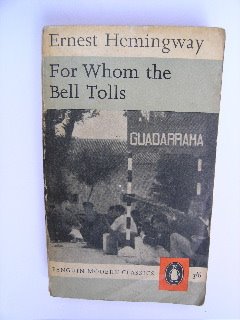
Book of books - For whom the bell tolls


It is quite an achievement to get a literary worked linked forever with an event but Ernest Hemingway achieved that with For Whom the bell tolls and the Spanish Civil War.

book context:
An account of the Spanish Civil War from the view point of an American explosives expert who is sent on a mission to blow up a bridge. Trough a story that lasts only four days we get a whole gamut of emotions ranging from love and lust for Maria to despair at the end and hatred and frustration on the way between. The sense of frustration about the way the war is managed that echoes from Orwell is highlighted with the mad French communist general but the added dimension to this story is the multiple view points that lead to the conclusion that all war is senseless and there are victims on both sides. Reading it against a backdrop of the 70th anniversary of the civil war (which it is this July) also made it resonate that little bit more deeply.

is it well written?
There are parts of the book that are so powerful, particularly between Jordan and Maria, and the climax of blowing the bridge that it puts the reader right in the action. His ability to step inside any of the characters including even those fascist soldiers fighting against Jordan is something that most other authors avoid sticking instead to one narrative position. Even at the end he reminds us that the officer Jordan is about to kill was one of those involved with fighting against Sordo.
There is a pace to the book kept going by the tension created between the principle characters and the mission. Hemingway continually draws on the palm reading Jordan received from Pilar early on and we can all guess it showed his death. He also highlights the battle between bravery and cowardice in the figure of Pablo.
Aside from the descriptions and the characterisation the other skill is weaving in at various points the story of the war and the differences between the two sides.

Should it be read?
It's rare that a book can appeal to someone without an interest in the context but this should be read even by those without an interest in the Spanish Civil War. It is a story about two sides fighting and the decisions that are made in a conflict and for that reason it could be about any conflict and is about human beings and not about generals and military manoeuvres. For anyone who starts to think that most American literature is obsessed by class and race this is a demonstration that there are other basic human emotions that can be tackled very cleverly indeed.

Leads to
This could be a springboard into more Hemingway, books on the civil war or as a spur to read some more American great writers. I am taking the later course because of the Beevor and Orwell stuff already being done. Hemingway will be returned to but just not yet.


Version - Penguin Modern Classics range, published 1961

Thursday, July 20, 2006

For whom the bell tolls post VI

So the book concludes in a flurry of death, frustration and tragedy. The pace is maintained by the switching back from Andres carrying Robert Jordan’s message trying to stop the attack to the tension in the camp about what the morning will bring. Then when the attack starts the action makes reading 50 pages feel like reading five.

Bullet points between pages 351 – 444

* Andres sets off to take the message but it takes a long time and he accepts he will miss the attack and when the message gets through it is too late

* Pablo returns with five rebels promising to fight for the cause

* Robert and Anselmo blow up the bridge while Pablo and the five new rebels dispatch the other sentry post

* Anselmo is killed as are two more of the group – Fernando and Eladio - and the five rebels who Pablo found are shot by him as he escapes from an armoured car

* As the remaining members of the group escape Robert breaks his leg as his horse is injured and signals to Pablo that he can’t go on because he will slow them down

* Robert convinces Maria to leave and then settles down with a gun to wait for the fascist troops to come.

It is too early to produce a full review of the book because its impact is still very fresh. But even now you can rank this as a brilliant novel that puts you in the minds of multiple characters allowing you to share the ectasy of love, the frustrations of war and the fear and dangers of action.

Will post a full review tomorrow.

Sticking with American writers will start Grapes of Wrath by John Steinbeck on Monday.

Wednesday, July 19, 2006

For whom the bell tolls post V

Things heat up immediately in chapter 21 with the moment when Robert, who is sleeping outside encounters a cavalryman and shoots him. That decision leads to a nerve racking day that culminates with doubts creeping in to Jordan and the end of Sordo's band in the mountains.

Bullet points between pages 253 - 351

* Robert shoots a cavalryman and then has to prepare the group for action

* He becomes in effect the leader of the group

* El Sordo and his forces are wiped out by soldiers and planes

* Robert sends a message through to General Golz trying to get the bridge blowing mission cancelled

* On the eve of the attack Pablo disappears taking some dynamite and the detonator

Where Hemingway differs from some authors is that he is determined to provide different points of view. Some others would stick with Jordan and relay that Sordo had been killed through the sounds of the battle and the discovery afterwards by Pablo of the corpses but he goes much further. So you get to be with Sordo when he dies, in the minds of the officers trying to kill him on the hill and get the responses to the action from Robert and those around him. You even get to be with the messenger he sends to Golz and get to share his feelings about the battle.

All of these view points add to the feeling this is starting to climax in the final day of the battle. Tomorrow should be an eventful day in the book...

Tuesday, July 18, 2006

For whom the bell tolls post IV

Third day into the book and it has been an opportunity for some of the main characters - Robert, Pilar and Anselmo -– to share their thoughts with the readers filling in some of the background to why they ended up fighting in the war.

You also get a fixing for the timing, 1936 or early 1937 and a clear idea of what drove the people to war and the anger they had for thosfasciststs living rich off the hard work of the peasants.

Bullet points between pages 149 - 253

* Pilar recounts how the uprising started and the violence she was involved with Pablo in cleansing their home town by killing all the fascists

* Robert starts to think about how long he will be with Maria and faces up to the problems blowing the bridge during daylight and the subsequent retreat

* He also recalls how he was Spanish teacher and the problems being classed as a 'red' might cause for his career

* Anselmo waits watching the road and the guard house and thinks about killing and how he wished he didn't have to do any more

* The relationship between Pablo and Augustin and to some extent the rest of the group starts to disintegrate but then it calms down although they all suspect Pablo heard them all planning to kill him

* Robert dreams of going back to Madrid with Maria if the mission is successful.

Things again are on a knife edge with Pablo becoming more unstable, the mission deadline looming and different reactions stirring towards Robert partly because of his growing love of Maria and partly because of the distance he has put between himself and some gyspy Spanish beliefs. Let's read on for more tomorrow...

Monday, July 17, 2006

For whom the bell tolls post III

Second major day into the book and it is starting to develop with some of the questions being answered and others lingering on. You can feel the tension mounting and fears about the war and the chances of success of the bridge blowing mission mounting in the small group of Republican fighters.

In terms of characters the old man Anselmo has faded into the background but Pablo's wife Pilar and the girl Maria have become stronger. Also some of the other members, who spent most of their time guarding the camp: Fernando, Augustin and the gypsy are getting fleshed out a little bit more.

Bullet points between pages 59 - 148

*It doesn't take long for things to develop between Robert and Maria

*Some of the group expected Robert to kill Pablo but he lets the chance go

*fascists send over bombers and fighters which scares everyone

*Rumours of republican forces blowing up the bridge are circulating the town

*Jordan links up with the other rebel group led by El Sordo

You are starting to get the feeling with the display of bombers and fighter planes, the heavy fascist troop movements and the mental state of the republican forces that the mission will end in disaster. Let's see what happens in the next chunk of reading tomorrow...

Sunday, July 16, 2006

For whom the bell tolls post II

As we go into the week ahead when For whom the bell tolls will be read I'd like to set the scene after the first four chapters. The main character is an American called Robert Jordan who is fighting against Franco's fascist forces with orders to blow up a bridge. We start the story with an American volunteer in the Spanish Civil War being ordered by general Golz to blow the bridge and then his scouting of the bridge and the rebel base in the company of an old man, Anselmo.

Bullet points between pages 1-59
*Jordan has to blow up a bridge
*The group Jordan has to work with are led by someone against the plan, a man named Pablo, but the others are generally supportive.
*Pablo has an argument with his wife where she calls him a coward and takes the dominant role
*The group Jordan is sent to work with have had previous experience of an American explosives expert Kashkin who seemed to have lost his nerve after his mission to blow up a train and later died
*Jordan meets Maria, a prisoner who was released in the train explosion the group was involved with and he is attracted to her and the feeling is mutual.

At the end of chapter 4 Hemingway has built up the tension about the mission, the group dynamics and the chances of success against the fascist forces. You don't know if the bridge will be blown or if it will but the group will be killed. Maybe Pablo will try to stop him and will he end up disappearing after the mission with Maria?

A great book should ask the reader questions and get you excited about when you next open the pages. So far Hemingway is living up to his reputation and the painting of the scene is excellent and the characterisation is good. My one complaint would be that unless you had some basic historical knowledge about the Spanish Civil War you would struggle to understand fully what the context of the story was. Some of the language - the use of Thou in particular - is obviously of the time and maybe hasn't aged well.

But he may put some historical background in later on let's see what comes in the next 100 pages tomorrow...

Saturday, July 15, 2006

For whom the bell tolls post I

Reading now...For whom the bell tolls by Ernest Hemingway
I read books ideally from a Friday to a Friday and so I just started this and am about 50 pages in. There is such a weight of expectation going into a Hemingway that comes from his reputation and the number of high profiles fans he has. So far the story has been sketched - the blowing up of the bridge mission - and the main characters have been introduced and you feel that at some point soon the pace will pick up and he his writing will really grab you. We'll have to see next week if that's true.