Showing posts with label Graham Greene. Show all posts

Tuesday, November 16, 2010

book review - The Ministry of Fear - Graham Greene


"'Your old fashioned murderer killed from fear, from hate - or even from love, Mr Rowe, very seldom for substantial profit. None of these reasons is quite -respectable. But to murder for position - that's different, because when you've gained the position nobody has a right to criticize the means. Nobody will refuse to meet you if the position's high enough. Think of how many of your statesman have shaken hands with Hitler.'"


Set against the terror of a blitzed out London one man has to solve a mystery that not only threatens his own life and sanity but potentially the safety of Britain in it's battle against the Nazi's.

Arthur Rowe starts off by buying a cake in a raffle by being tipped off by the fortune teller to its exact weight. He isn't the man meant to get the cake and soon afterwards a whirlwind journey begins that first sees someone attempt to poison him then to have Rowe framed for the murder of a man at a seance.

A bomb dropping and wiping out his memory saves him from being killed but the sense that he will solve the mystery surfaces again and in a story that reminds you of 39 Steps and in moments of some of the Bond's the book moves to a gripping conclusion.

To say anymore would give too much away and spoil the enjoyment for others but what is safe to say is that Greene is having fun here. The plot weaves and runs with the reader, as well as Rowe, never knowing who can be trusted and which side is good or evil. The fact Rowe is himself is a murderer is a brilliant twist that establishes that confusion about which side to back.

Despite his past the reader sides with Rowe and wants him to succeed. To a degree he does but finding out who you really are can be a terrible price to pay.

One of the other highlights of the book along with the plot is London itself. Greene describes a bombed and fearful London in a way few other writers have and manages to place a reader into a world where a sound overhead could mean death or a near miss.

Taking you down into the strange world of those who sleep on the underground Greene uses London brilliantly to evoke the sense of shifting ground and danger that is also being played out between Rowe and those determined to find out what he knows and kill him.

Monday, November 15, 2010

Thoughts at the half way point of Ministry of Fear

Arthur Rowe is a simple man who wanted to kill a bit of time at a church fete but by winning the guess-the-weight-cake he triggered a series of events that meant it was him not just time that was being killed.

Greene introduces the reader to a blitzed out London and a dreary world of rented rooms and the sad world of those unable to fight, left behind in the war torn capital.

As the story starts to unfold things go from strange to horrific for Rowe as he is accused of murder and ends up having to disappear underground to escape the law. One light shines in the darkness but with an Austrian background and links to the cake perhaps Anna Hilfe isn't the friend Arthur Rowe is hoping she might well become.

A review soon...

Friday, December 11, 2009

book review - The Tenth Man - Graham Greene


If you want an example of what graham Greene is all about and you are not prepared to invest the time and effort to engage with one of his longer books then this slim story will serve the purpose of introducing you to the great man.

What is on display in a relatively short and tight story about a man who has signed away his fortune to save his life and then the facing of the consequences is the characterisation and tone of voice that is there in Greene’s literature.

The tale seems relatively simple with the action kicking off in a prisoner of war camp in occupied France. Lots are drawn with the tenth man facing the shooting squad. A rich lawyer Chavel draws the lot but offers to give all of his money and his large house in the country to anyone who will take his place. This cowardly act is actually taken up by a poor man Janvier who wishes to at least die rich.

After the war Chavel heads back to his house and lives as a handy man under the same roof as Janvier’s sister and mother. They are both waiting for Chavel and are terrorised about it. When an opportunist finally comes calling it throws everything into confusion and the hate that the sister actually thought she felt turn more to forgiveness.

Chavel faces the choice to reveal his true identity or take the opportunity of having someone else take the part of the shadow that has fallen across his and the lives of the mother and sister.

As a reader you might feel you know where the book is going, so many times it feels as if you can predict the next plot development. But what makes it interesting going through the story is the ability of Greene not just to surprise but deliver such believable characters that you are prepared to go through scenes to see the reaction.

He operates with a tight cast, a shadow over hanging the whole piece as the principal character wonders if his secret will be discovered and then an ending which you could not have predicted but is well worth waiting for.

What he really writes about so acutely are human beings and their motivations and emotions. He nails it in a very short space of writing and manages to drop a backdrop that sets a mood. He can do it in the jungles of Africa, a blitzed London and again here in post-war rural France.

Wednesday, October 07, 2009

The Tenth Man - post II

It seems like a long time ago since the first half of this book was read but you pick it up and delve straight back into the tight relationship between the former prisoner of war and the sister of the man he traded death with at the loss of his fortune.

Just as you think you know where the story is going, into some sort of love story that is cast right open with his confession of true identity, Greene brings in a third character and takes it in a slightly different direction.

His writing is so economical that you are given the chance to concentrate mainly on one person. Even then a lot of it is brush strokes with you as a reader filling in the gaps. Sometimes just a simple sentence is left with you racing ahead to work out the consequences.

A review will follow soon...

Saturday, September 19, 2009

The Tenth Man - post I

Graham Greene has such an easy style that although you know there might be some plot developments that make uncomfortable reading you will get round them in the luxury of a smooth fashion. He is in total control and taking you by the hand into his well described world.

Here the book starts slightly differently with a 33 page introduction by Greene explaining that he was working for Metro-Goldwyn-Mayer and had to write some film scripts. The Tenth Man was one of the works he produced. He talks about Our Man in Havana and the way he pulls things together from relatively small ideas.

Here the tenth man is a lonely lawyer Louis Chavel who draws a lot to be killed but ends up swapping his fortune for his life. But he then returns to his former home, now lived in by the mother and sister of the man who died in his place, and starts to live under the same roof taking a role as a handyman.

You guess that Chavel would fall in love with the sister of the man he sent to his death and you sense that she will discover. That might make the plot seem simplistic but the craft in the writing makes you stick with it because you never quite know where it will go.

More soon...

Monday, April 13, 2009

book review - The Human Factor


There is a something about Graham Greene that can best be described as a voice. Every book of his I have so far come across has the same rhythm and gives off a sense of having been written with confidence.

This book starts with you under the impression that it might well be a humorous reaction to the world of Ian Fleming and glamorous spies as it focuses on a couple of men working in an African sub-section of the Foreign Office.

But the humour evaporates as a leak is discovered in the department and the finger of suspicion points not at the older man Castle but at his younger frustrated and bored colleague Davis.

The jokes about glamour and Bond are a clever counterpoint to the bungling class based decisions that are taken to eradicate Davis and then play further games to smoke out the real leak.

But this is against a background of the cold war defections that gained headlines and embarrassed the establishment. Castle is playing for high stakes and fails to understand that principles are not honoured in this war of information. In the end he loses all that really matters to him, his wife and adopted son, and without his protection the world they live in looks bleak in the extreme.

As the wheels of government, class and espionage turn in between the cogs are the normal men and women who are victims. Some like Castle believe that there are higher principles at play here but in reality it is a rather pathetic game of trying to trump the opposition.

Defectors are pawns in a game they don’t really understand and operating in a system that despite relying so much on people has no understanding or place for the human factor.

Wednesday, March 04, 2009

The Human Factor - post V

The depth of characterisation means that even when the lead Castle does something you might not agree with you view him sympathetically. He certainly needs a lot of it at the end because he ends up ruining his routine abiding life by opting to do what he believes is right but in actual fact he is wrong.

Not wrong in the sense of wanting to fight apartheid but wrong in his failure to understand how the system works and how he is quite capable of being used as a pawn by both sides.

Ultimately if Castle was guided by love of his wife and adopted son then it is the separation from them that shows so clearly how he has failed and he is left alone and cut-off unable to protect them anymore.

On one level this is a cat and mouse game of spy versus spy but on another level it is about human values and what is right and wrong. That comes down to an individual level. But sadly even those who want to resign in protest can’t make a difference and those who try to share information are just temporary flies in the ointment and the real losers are themselves.

Brilliantly observed and political without preaching not just about South Africa but also the cold war and the class system.

A review will follow soon…

Tuesday, March 03, 2009

The Human Factor - post IV

I had hoped to finish this today but in a way it's not such a bad thing that I get to enjoy it tomorrow. Greene slips in twist after twist as he unpeels his characters like onions. At their centre are their real emotions and the feelings that they all have - hence the title.

Castle's mistake is to love too much and to keep the loyalty going even after the ability to protect himself has gone.

Of all the books I have read that touch on the subject of apartheid this is one of the most powerful. The south African Muller simply cannot understand why anyone would want to see an end to the race laws even when the oddity of extreme hatred is exposed in another climate.

There are also plenty of jokes at the expense of Ian Fleming with the mundane cruelty of the real secret service being something quote different from the world of James Bond.

What will happen to Castle? But also what will happen to the others? Final chunk tomorrow...

Friday, February 27, 2009

The Human Factor - post II

There are lots of references to James Bond and although the point is made that in real life spying is nowhere near as glamorous or interesting the threat of death is real.

The two men believed to have the makings of a double agent are Castle and his colleague and it is Davis that the authorities make their target. He has the tip-off from Castle that a leak has probably happened and they are trying to turn the pressure up but he seems to take it all as a joke.

In parallel the pressure is also being put on Castle, who constantly dreams of retirement, with the ghosts of his past in South Africa coming back to haunt him in his own home.

The upshot of it is that at the top of the tree those running the department have a complete disconnect with those they are in charge of giving rise to both humour and tragedy.

More Monday...

Thursday, February 26, 2009

The Human Factor - post I

Taking a slight break from 2666 between parts 2 and 3 and squeezing in something slightly easier on the eye and brain.

Graham Greene is always an interesting author not just because of his plot construction but also because he has an uncanny ability to dissect people and get to the heart of the matter (pardon the pun).

He is on form again with this story that mixes humour, great characterisation and an acutely observed world of secret agents and government bureaucrats.

The world of Maurice Castle is opened up with the 30-years in the job agent struggling to maintain an interest in his job following African affairs. He is on the brink of retirement and would quite happily slope off home to the wife he loves and the adopted son he has made his own.

But duty calls and when a new boss arrives and a leak in the department is identified the humdrum world of Castle and his colleagues looks like being severely disrupted.

More tomorrow…

Sunday, March 04, 2007

book of books - Our Man in Havana


You come to this book by Graham Greene expecting it to be like James Bond but with a laugh a minute and although it is a humorous look at the world of spying it is far from being slap stick and there are victims that get caught up in the games that are played but become all too real. If anything this is a satirical critique of the ease with which the game of spying can spiral out of control.

Bearing in mind it was set in pre Castro Cuba, but came out in 1958 when the tension over the country was nearing the heights that saw it involved as a battlefield on two major occasions in the Kennedy administration, once for real and the second politically, it adds spice to the spying activities.

Plot summary
A British vacuum cleaner salesman Wormold living with his daughter Milly is drifting along losing money, still bruised after his wife left him and getting into deeper trouble because of his daughter’s spending habits. Then he is approached by a man named Hawthorne who recruits him to become the secret service’s man in Havana. He is advised by his German friend Dr Hasselbacher to make up the reports but just after a secretary is sent out from London to help him the characters in his reports start to come true and end up dying or being shot at. Things culminate with Wormold having a poisoning attempt made against him and then shooting the would be poisioner before fleeing back to the UK but not to disgrace but an OBE and a life being looked after not just by the secret service but also by his secretary who has fallen in love with him.

Is it well written?
You move from laugh out loud moments, for example when Wormold is recruited in the toilets, to moments that seem to be like The 39 Steps including the moment when he realises he is about to be poisoned. Then you get the moments of sadness, when Dr Hasselbacher is murdered and Carter. To be able to go from those moods seamlessly and leave you with a warm feeling at the happyish ending is a skill. On top of that you get a feel for what pre-Castro Cuba was like with the country already being seen as the players in the Cold War as a battleground of influence and control.

Should it be read?
It is a pretty accessible Greene and so that is in its favour. The story flows along which also helps and it has a reputation that is slightly more crowd pleasing than some of his other novels. Against a backdrop of some of his other work it deserves to be read not just to show his flexibility but also to show his methodology in painting an accurate picture of a location, building strong characters and developing a plot that has the capability to involve and surprise the reader.

Summary
Playing at spies leads to loss and love in pre-Castro Cuba but reminds you powerfully just how much of a lethal game spying was during the cold war

Version read – Penguin paperback

Saturday, March 03, 2007

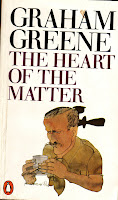
book of books - The Heart of the Matter


The idea of having a battle with God is an ongoing theme in Graham Greene’s work and appears in The End of the Affair, Power and the Glory and A Burnt Out Case. Although it is a personal process the impact of a religious struggle of the main character does have an impact on everyone who touches that person.

The beauty of Green’s books is that there are so many subtle touches that you almost miss but then remember like Scobie writing in “I love you’ in Helen’s stamp album or the way he was the last person to speak to a child before his death.

Plot summary
The story focuses on Scobie a policeman in an English colony who is struggling to please his wife Louise who is unhappy in the heat and with the disappointment of her husband’s failure to become commissioner. Against that background a man sent out undercover to try and stop the industrial diamond smuggling to Germany, which is at war with rEurope, falls in love with Scobie’s wife and Wilson although never actually trapping Scobie becomes a shadow over his happiness. Scobie borrows money from a Syrian criminal Yusef to pay for his wife’s passage to South Africa and then falls in love with Helen Rolt, a 19 year old widow who is pulled out of a convoy sinking as a result of a submarine attack. As Louise returns, Helen becomes more demanding, the pressure from Yusef forces him into criminal acts Scobie decides to end his life and although as a Catholic that is a mortal sin he opts for that way out.

Is it well written?
It is unusual in that on some levels the story appears to be easy to predict in that you know that Scobie will be tempted and that Wilson will try to catch him. But because not just of a few twists thrown in to make the plot a bit more complex but also because of the writing it keeps you wondering how it will end until the end. Although you know the broad brush strokes there is a real depth here with the battle becoming not just between Scobie and his real adversaries but between the policeman and his god, what he believes in, and that can only come across as a result of internal dialogue that Greene is so capable of delivering.

Should it be read?
It is one of the books that comes down on the list of titles to visit first, and that is probably part of the curse of enjoying a writer who was so prolific. But it deserves to be read not just if you appreciate Greene but if you want to get a European take on the Kafka type pushing and pressuring on a main character that finds that in the end the only way out is through death.

Summary
Scobie, a policeman that upholds the law, breaks it and loses the peace he has enjoyed for 15 years and decides to end his life when he realises he will never have peace again

Version read – Penguin paperback

Friday, March 02, 2007

Our Man in Havana - post III

Although this book is always referred to as a comedy there are still some of the same heart rendering moments that populate books like Power and the Glory and Heart of the Matter and one of them here is the moment when Wormold ends up killing Carter just after discovering that he is a human being and not just a foot solider in the war of imaginative spies.

“He was a man. I’d learnt a lot about him. He couldn’t undo a girl’s corset. He was scared of women. He liked his pipe and when he was a boy the pleasure-steamers on the river at home seemed to him like liners. Perhaps he was a romantic. A romantic is usually afraid, isn’t he, in case reality doesn’t come up to expectations. They all expect too much.” Pg204


Bullet points between pages 126 – 220

* The consequences of Wormold’s imaginary world continue to reverberate around Cuba as he tries to warn his agents and ends up in the police station being questioned by the chief of police who also fancies his daughter about his actions

* Hawthorne calls Wormold to Jamaica to warn him that the invitation to speak at the traders association is in fact the opportunity his enemies have been waiting for to poison him but insists he has the meal to expose the enemy agents

* The main victim of all of the intrigue is Dr Hasselbacher who is shot twice later in the evening after warning Wormold about the poisoning attempt as he walks into the dinner to give his speech

* The poisoner turns out to be a fellow Brit that Wormold thought he could tryst but he realises as Carter slips him some whisky that it is spiked and so gives it to the headwaiters dog who dies as a result

* After coming clean to Beatrice, who he reveals he has fallen in love with, he decides that he will leave and return to England but not before getting the list of agents off the police chief who has proposed marriage to his daughter

* After drinking the police chief under the table Wormold takes Carter out for a drive and works himself up into a position to shoot him but hits his pipe and is about to leave but kills Carter after being shot at himself

* He returns to England where his lies are exposed but he is rewarded with an OBE and a position in the secret service and he declares his love to Beatrice and although he is not quite as a mad as she would like they vow to stay together

Review will follow over the weekend along with the review of Heart of the Matter, which I should have done but became too engrossed in this book…

Thursday, March 01, 2007

Our Man in Havana - post II

Just as the story seems to be going beyond humour into somewhere dark and embarrassing as Wormold’s fabrications are discovered by his secret service secretary Beatrice things take a bizarre twist. The phrase ‘truth is stranger than fiction’ takes on a new meaning as characters that come from the mind of the vacuum cleaner salesman’s head begin to populate the city.

Bullet points between pages 60 – 126

* Life starts to improve for Wormold as he starts to send back fictitious reports and draws sketches of military weaponry based on sketches of vacuum cleaner parts and draws expenses for sub agents that don’t exist

* Back in London Hawthorne starts to suspect that something is wrong when he looks at the sketches but everyone else is falling for it and so the next stage is to send out a secretary and a radio operator

* The secretary arrives on Milly’s seventeenth birthday and starts to revolutionise the life of Wormold and insists on meeting his agents, something he tries to avoid at all costs, plus she encourages him to steer clear of Dr Hasselbacher

* Things seem to be coming to a head when Beatrice the secretary is on the brink of guessing that the pilot Raul, who Wormold has asked to do a flyover of military installations, is a fiction that will conveniently die

* Then they discover that Raul has been murdered in a set-up accident on the way to the airport, that the agent Wormold claimed was working for him has been shot at by the police and all of a sudden the world of make believe is becoming real

More of this cracking story tomorrow…

Wednesday, February 28, 2007

Our Man in Havana - post I

The country might be different and the characters new but Graham Greene still has an eye for detail and of course the Catholic Church makes an appearance. What makes this book more of a light hearted read is that the main character Joe Wormold a vacuum cleaner salesman is not only non-religious but much more likely to have a crack at living life in more of a way than poor Scobie did in Heart of the Matter.

Bullet points from pages 1 – 60

* Wormold is a man under pressure with a beautiful and shopaholic daughter, a business that is suffering and a love for a wife that left him to run off with an American and to top it all he is an Englishman coping with all of this in Havana

* Then things take a mysterious turn when an English visitor visits his vacuum cleaner shop and then approaches him later to become a secret service agent for the British secret service in Cuba

* Because his daughter has expensive habits, which include a horse and membership of the country club, he ends up0 taking the position as the agent on the island responsible for recruiting some sub agents and sending in reports to London

* He has no idea what he is doing but reveals what has happened to his friend a German doctor Hasselbacher who advises him just to start making things up which Wormold starts to do waiting anxiously to see if his report has been accepted by Hawthorne, his handler in London

More tomorrow…

Tuesday, February 27, 2007

The Heart of the Matter - post IV

Poor old Scobie he reminds you of a Kafka character as he drifts through the final stages unable to resist the inevitable end being bullied by his wife, mistress, blackmailer and God. With Wilson, whom you never really get to see other than glimpses, Greene creates a character that you loathe because even after Scobie has died he is after him trying to prove he committed suicide. But presumably that is the fortune teller getting it right because he does catch his man, even after death.

Bullet points between pages 210 – 272

* With his wife back Scobie faces pressure over his relationship with Helen and is dragged along to communion and Mass in an attempt by his wife to get him to turn his back on his adultery something she becomes aware of after Wilson tells her

* Ironically Scobie is offered the position of Police Commissioner after all, which makes his wife happy, and had it happened earlier would have meant he could have avoided all of his current problems

* The struggle with God becomes almost an obsession for Scobie as he confesses frankly to the priest and keeps calling for some sort of divine retribution for his continuing sins against God and his wife

* Scobie starts to believe he cannot trust anyone and visits Yusef and opens up to him telling him that he can not even trust his servant Ali who is then sent for but turns up dead outside the Syrians office with his throat cut

* That seems to mark the turning point and after that Scobie imitates the symptoms of angina and starts storing the tablets for a fatal overdose, which he takes hoping that although it means as a catholic he is dammed he has at last found peace

* But after the death Wilson comes sniffing round and points out that entries in the diary to emphasise the illness have been added and suggests suicide a thought that obviously sticks with Louise his widow because the book ends with her arguing with the priest over why he committed suicide

A review follows in a couple of days after this has all been mulled over. Next up for a change in tone but from the same author I’m going to dust off a copy of Our Man in Havana that has been on the shelf for the past couple of years…

Monday, February 26, 2007

The Heart of the Matter - post III

This is so well written because just as you think you can predict what happens next the plate’s shift and Scobie’s wife returns, Yusef moves from menacing friend to out and out blackmailer and there is still the threat of Wilson to come.

Bullet points between pages 140 - 210

* The relationship between Scobie and the child (19) widow Helen moves from friendship to love and things are sealed with an evening stay and presumably, although this is not gone into in depth, a bit of something physical

* Harris and Wilson, two occupants from the hotel, move in together in a hut next to Helen and Harris discovers in their old magazine that Wilson has written a poem about his love for Louise Scobie

* Scobie has a meeting with the commissioner and the truth about Wilson being some sort of government agent and the commissioner reveals that Scobie is being suspected as a blackmail victim by Yusef the Syrian and that Wilson trusts nobody

* The relationship between Scobie and Helen starts to get fractious after she accuses him of being so careful in their relationship he hardly cares and in response he writes her a very emotional love letter which disappears

* The reader suspects, and you feel Scobie does as well, Wilson as being the culprit but it turns out to be Yusef’s boy who has stolen the letter and as a result Scobie can be blackmailed to take a package onto a ship set for Portugal

* Scobie is in a corner because he wife has telegrammed to say she is returning so he cannot afford to have his affair revealed so takes the package and now has compromised everything and the lies keep coming when Louise returns

Of course we know that Yusef’s boy is in the pay of Wilson so the chances are that both the details of the love letter and the package blackmail will be known by someone keen to get him out of the way with the woman they love back on the scene. More tomorrow…

Saturday, February 24, 2007

book of books - The Power and the Glory


Graham Greene does something rather clever having a main character that is nameless who grows throughout the book to represent something bigger than himself. In the end he is not the martyr but the cause he believes in is. Although this book came in for some flak because it has a priest who more than likes a tipple and has a daughter, it shows that even a priest is capable of going on a spiritual journey. The destination of his journey is not just death but enlightenment with him realising that to die for his faith is his purpose and the one last way to wipe away his sins.

Plot summary
Based in Mexico against a backdrop of persecution against the Catholic Church a priest is hunted down by a lieutenant who makes it his job to catch him and bring him to justice. In parallel there is an American gangster on the loose and the authorities set out to get him as well. The priest wanders through communities he knows but is eventually shunned because the police are taking hostages and shooting them unless they tell them where the priest is. After encountering a Judas figure who plans to drop the priest in it for the reward the priest lies low but his need for alcohol lands him in trouble and he is caught with a bottle of brandy and put in prison where he confesses who he is but the people protect him and in a way he finds heaven in hell. He then heads for the border and after finding a victim of the American gangster gets across to safety but the Judas comes looking for him and drags him back across the border to give last rights to the dying American and then the police capture him. He is sentenced to death and shot but that same evening another priest arrives.

Is it well written?
What you start to appreciate with Greene is that although the plot can sometimes become obvious there is such a depth to his characters and description of locations you end up wishing that it would all last longer. Both the priest and the lieutenant chasing after him are unnamed and both are united by a passion and then resignation that they have to follow what they believe in. There are lots of subtle gearshifts that keep you guessing quite what will happen but you always know that the only way the whiskey priest can find salvation and peace is at the end of a gun. Likewise Greene leaves you with a sense that no matter how hard the authorities try they will never succeed in getting rid of the priests.

Should it be read?
A few years ago Time listed this among its top 100 books and the reason is because partly the controversy it caused, with the Catholic Church understandably frowning on the depiction of a priest with a daughter and a drink problem. But it is also on that list because of the writing and although I have never been to Mexico you can start to appreciate the villages and the landscape as a result of Greene’s prose. The other slight problem for this book is that along with The Heart of the Matter and The End of the Affair and to some extent Brighton Rock this gets lumped together with those as a ‘catholic’ novel and while that is true it does deserve to stand alone as a work and it could be read without reference to those other books.

Summary
A whiskey priest breaking all the rules discovers that death is its own reward and those who kill him face a struggle they will ultimately lose to stamp out a religion

Version read – Vintage Classics paperback

Friday, February 23, 2007

Heart of the Matter - post II

There is a bit in Star Wars when Obi-Wan Kenobi tells a young Luke Skywalker in a short monologue what the history of the rebellion and clone wars was all about and it sets things up nicely. There is a similar moment in this book where an Indian fortune teller explains to Wilson (and the reader) how the story will roughly unfold over the next hundred or so pages. Letting the reader in on the story is a device that some writers use so it will be interesting to see how Greene makes it work.

Bullet points between pages 52 – 140

* The desire of Scobie’s wife to depart for South Africa starts to cast a long shadow over his daily life and he starts to dread the subject coming up with his wife when he gets home

* Wilson eventually gives into the fortune teller waiting outside his rooms and allows his palm to be read and he is told that he will catch his man and sail away with the woman he loves

* Any doubts you might have had about the woman he loves are dispelled when he declares his love for Scobie’s wife Louise and doubts that the man he catches might be Scobie start to melt away as he in linked with a corrupt Syrian who has lent him the money to pay for Louise’s passage

* The Syrian, Yusef, keeps hinting to Scobie that Wilson is a secret agent sent to try and get to the root of the illicit trade in industrial diamonds and has a show down with Scobie after some victims of convoy torpedoing are buried

* Wilson accuses Scobie of sending Louise away because he knew that she loved Wilson but Scobie denies this but then gets a glimpse into the venom the man is storing up for the policeman as he asks him where he got the money for to pay her passage

* Things end with Scobie helping a young teacher who has lost her husband in the sea crossing and has only just started to come to life again after being saved and helped by doctors

Things are hotting up not just between Scobie and Wilson but also between Scobie and the young widow…

Thursday, February 22, 2007

The Heart of the Matter - post I

Keeping with not just Graham Greene but also with one of his Catholic novels you go from Mexico to a West African colony and from one main character with no name to another with one that is pretty memorable. Within pages you are slowly engaged with the hot and frustrating life of Scobie and the problems he faces at work and at home.

Bullet points from pages 1 – 52

* Things start with a new arrival, Wilson, looking down from a balcony and being introduced to the heat, the cynicism and Scobie, a moment that Greene describes as something he will remember in the future

* Then the story switches to Scobie who is informed by his boss that although he is retiring Scobie has been passed over and is now expected to retire, an option that Scobie turns down despite the problems it will cause for him with his wife

* His wife Louise has no friends and is desperate to leave the colony and begs her husband to retire or at least let her move to South Africa where she has some friends who like her, instead of just Wilson who she meets and shares a mutual interest in poetry

* Scobie asks the bank for a loan but is turned down and starts to muse on the possibility of accepting bribes as one way of finding the money to pay for his wife to leave and travel to South Africa

Just like Tench in The Power and The Glory, Scobie is trapped by his lack of funds not being able to pay for passage out of the country. Quite what he will do about it remains to be seen. More tomorrow…